
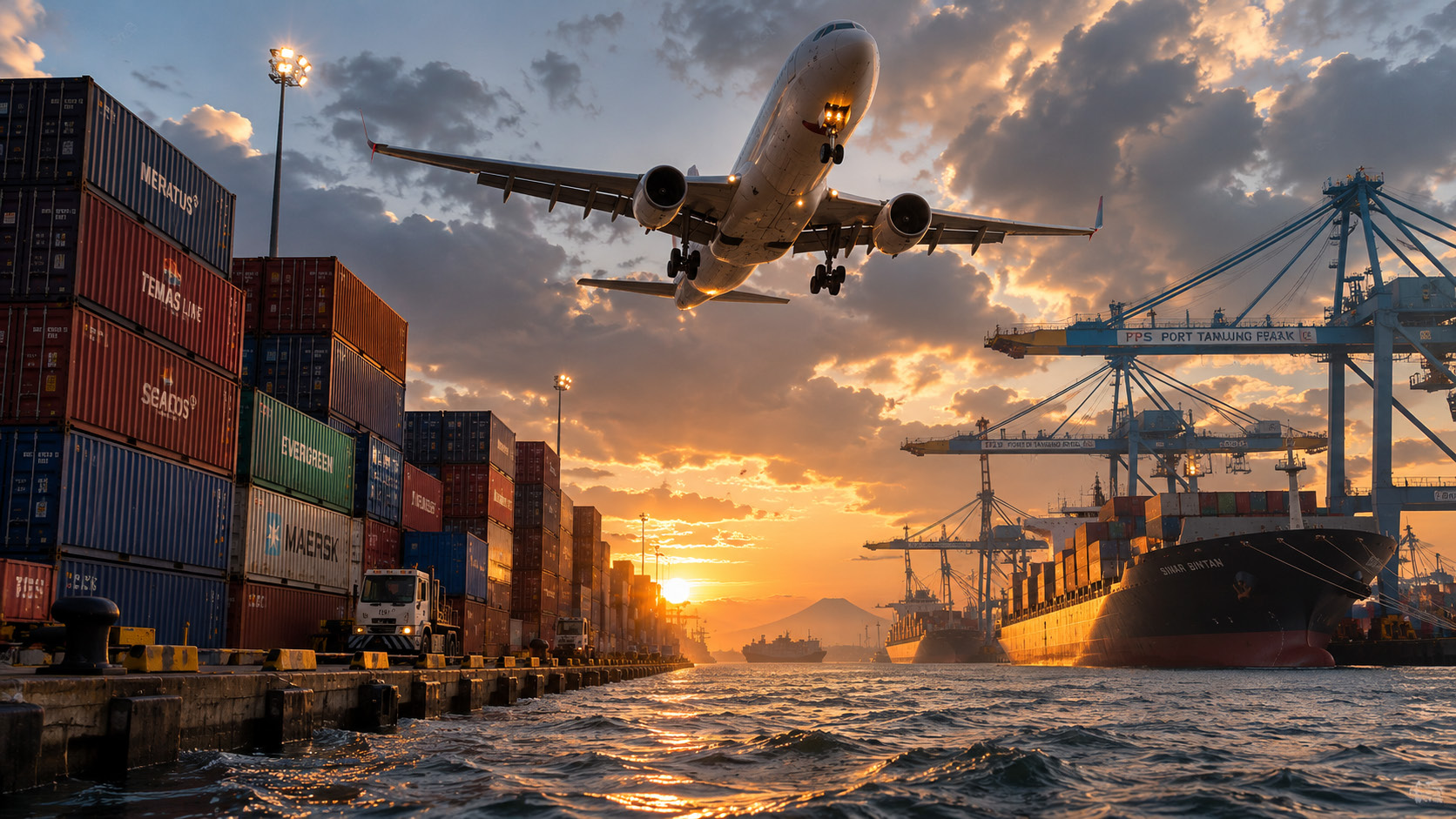
Choosing between ocean freight and air cargo is one of the most critical operational decisions in international supply chain management, directly dictating both working capital and customer satisfaction.
1. Transit Time Considerations
Air freight is unquestionably the champion of velocity. While ocean shipments between East Asia and Indonesia might take 7 to 18 days depending on port congestion, international air cargo commonly delivers within 24 to 72 hours. For perishable goods, pharmaceuticals, or emergency machinery replacement parts, air freight is the undisputed choice.
2. Cost and Freight Weight Economics
Ocean freight offers immense cost economies of scale. Containerized maritime shipping (FCL 20ft or 40ft High Cube) is typically 4 to 6 times more economical per kilogram than airfreight. For bulky commodities, heavy industrial raw materials, and high-volume consumer goods, sea freight delivers unbeatable margins.
Comparative Analysis Table
| Factor | Sea Freight (Ocean) | Air Freight |
|---|---|---|
| Cost | Significantly lower per kg | Higher premium per kg / volume weight |
| Speed | 1 to 4 weeks depending on lane | 1 to 3 days |
| Capacity | Ideal for heavy & out-of-gauge cargo | Strict weight & dimensional restrictions |
KSL provides dedicated multimodal freight forwarding programs, allowing clients to balance urgency and budget through hybrid sea-air strategies.